




Workflow on WooCommerce Global Cart with shops using different currencies
Running a WooCommerce Multisite network can be an effective way to operate multiple online stores from a single WordPress installation. This approach is particularly useful for businesses selling internationally, where each market may require its own domain, language, pricing strategy, payment methods, tax configuration, and currency.
One common requirement is to allow each shop in the network to use a different currency while still giving customers a unified shopping experience. For example, an international business might operate one shop in the United States using USD, another shop in the European Union using EUR, and another regional shop using GBP or a local currency.
WP Global Cart is designed to make this type of Multisite setup possible by connecting the shopping experience across the individual WooCommerce shops. Customers can use a shared account and Global Cart while the individual stores remain independently configured.
Using Different Currencies Across WooCommerce Shops
WooCommerce allows each site in a WordPress Multisite network to define its own currency. This means that the stores do not need to use a common currency simply because they belong to the same network.
For example, you could configure:
- US Store — US Dollar (USD)
- European Store — Euro (EUR)
- UK Store — Pound Sterling (GBP)
Each WooCommerce installation can maintain its own currency settings through WooCommerce > Settings > General.
This is especially useful when the stores are designed for different geographical markets. Displaying prices in the currency customers are accustomed to can make the shopping experience easier to understand and can prevent confusion when customers compare product prices, shipping costs, and order totals.
The currency should be configured independently on each shop according to that store’s business requirements.
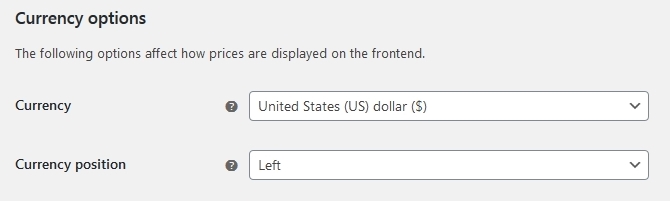
Once the currency is configured for a particular shop, WooCommerce automatically uses that currency when displaying product prices throughout the store. This includes product pages, shop archives, cart pages, checkout pages, and other WooCommerce interfaces where prices are displayed.
For example, a product sold on the US store could be displayed as $100.00, while the equivalent product on the European store could be displayed as €100.00, provided that the product and pricing have been configured accordingly on those individual shops.
The important point is that the shops remain independent from a currency configuration perspective. Using WP Global Cart does not require every shop in the network to use the same currency.
How Global Cart Handles Products From Different Currencies
The interesting part begins when a customer adds products from more than one shop to the Global Cart.
Because the products can originate from different WooCommerce stores, the cart may contain products associated with different currencies. WP Global Cart keeps the currency associated with each product rather than simply forcing all products to use the currency of the shop currently being viewed.
For example, a customer could visit the US store and add a product priced at $50 USD. The customer could then visit another shop in the same network using EUR and add another product priced at €40 EUR.
The Global Cart can contain both products while retaining their respective currencies.
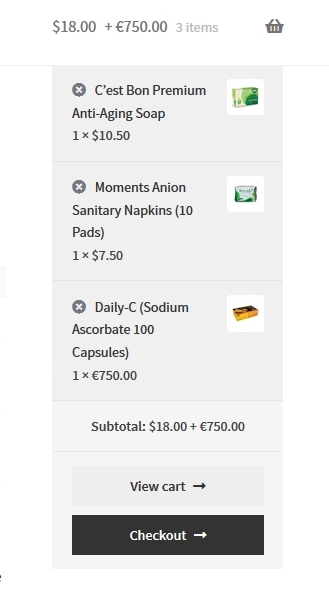
This is an important distinction for international WooCommerce networks. The Global Cart should not be treated as a currency-conversion tool. Instead, it provides a unified cart experience while respecting the currency configured for the individual stores and products.
As a result, the customer can browse products across the different shops without losing track of which store each product belongs to or which currency applies to its price.
Using “Each Store” / Split Checkout
When shops in the network use different currencies, the recommended checkout configuration is Each Store (Split Checkout).
With this workflow, products are separated according to the shop from which they originated. Each store can therefore process its own part of the customer’s purchase using the currency configured for that store.
Consider a customer who has the following products in the Global Cart:
- Product A from the US shop — $75 USD
- Product B from the European shop — €60 EUR
- Product C from the UK shop — £40 GBP
Rather than attempting to convert all three currencies into one currency and create a single order, the Split Checkout workflow keeps the products associated with their originating stores.
This approach is especially useful when the individual stores also have different payment gateways, tax rules, shipping methods, or legal entities. Each store can continue to operate according to its own WooCommerce configuration while WP Global Cart provides the connection between the shops.
For businesses operating multiple regional stores, this can be significantly more practical than trying to create one WooCommerce store with every country’s currency and business rules combined into a single configuration.
Using a Single Checkout with Currency Conversion
A Single Checkout setup can also be used when the shops operate with different currencies. In this scenario, instead of keeping each product in its original store currency through checkout, a currency conversion plugin can be used to convert all cart prices into the currency of the site where the customer completes the checkout.
For example, a customer may add a product from a USD shop and another product from an EUR shop. When the customer proceeds to checkout on the local site, the currency conversion plugin can convert the USD product into EUR, allowing the entire cart to be processed as a single order in the local site’s currency.
This approach can be particularly useful when the customer experience should be as simple as possible and the business prefers to have one checkout, one order, and one payment transaction, rather than creating separate orders for each store.
The workflow can therefore be:
- The customer browses products across the different shops.
- Products from different stores are added to the Global Cart.
- The customer proceeds to the checkout of the selected/local shop.
- A currency conversion plugin converts products from other currencies into the checkout site’s currency.
- The entire cart is processed through a single checkout and payment.
This setup gives the business more flexibility when choosing between Split Checkout and Single Checkout. Split Checkout is generally more appropriate when each store needs to independently process its own order, payment, currency, taxes, or other WooCommerce settings. Single Checkout, combined with currency conversion, can be a better option when the goal is to provide customers with a unified checkout experience and process the entire purchase in one currency.
The important requirement is that the currency conversion plugin must be compatible with the WooCommerce configuration and the way prices are passed to the Global Cart and checkout. The conversion should be applied consistently to the cart totals, shipping, taxes, discounts, and other amounts involved in the checkout process.
Why a Multi-Currency Multisite Setup Can Be Useful
Using separate WooCommerce shops for different markets provides considerably more flexibility than simply displaying multiple currencies on one website.
Each shop can be tailored to its target market. Besides currency, you can maintain different:
- Domains or subdomains
- Languages
- Product catalogs
- Product prices
- Shipping methods
- Payment gateways
- Tax settings
- Branding and marketing content
- Regional promotions
At the same time, WP Global Cart can connect these stores so customers can move between them without experiencing each website as a completely isolated shopping environment.
This makes the architecture particularly useful for companies that have a global presence but still need to maintain separate regional operations.
Currency and Product Synchronization
Another important consideration is product synchronization.
When the same product is available across multiple shops, the product information can be synchronized between stores while the individual shops still maintain their own WooCommerce configuration. This can be useful for keeping product descriptions, images, inventory information, and other product data consistent across the network.
However, businesses should decide carefully how pricing should work across markets.
A product that costs $100 USD in the US does not necessarily need to have the direct numerical equivalent of €100 EUR in Europe. Regional pricing may be influenced by taxes, shipping, market conditions, competition, purchasing power, and local business costs.
For this reason, an international store network should distinguish between product synchronization and currency conversion. Keeping product information consistent does not necessarily mean that the final selling price should be identical in every market.
Final Workflow
A typical WooCommerce Multisite setup using different currencies can therefore work as follows:
1. Create the individual WooCommerce shops.
Each shop can target a particular region, country, language, or market.
2. Configure the currency for each shop.
Use WooCommerce > Settings > General and select the appropriate currency independently for each site.
3. Enable WP Global Cart across the network.
This allows the stores to participate in the shared Global Cart experience.
4. Add products from different shops to the Global Cart.
Products can retain the currency associated with their originating shop.
5. Use Each Store / Split Checkout or Single Checkout.
The products are separated by originating shop, allowing each store to process its own order using its configured currency. Or a unique checkout when Single Checkout set-up type.
This structure provides a good balance between a unified customer experience and independent regional store management.
For businesses running WooCommerce across multiple countries or legal entities, using separate stores with their own currencies can be much easier to manage than forcing all markets into one WooCommerce configuration. WP Global Cart bridges these stores at the customer and cart level while allowing each shop to retain its own operational setup.
The result is a flexible WooCommerce Multisite architecture where customers can browse and add products across multiple regional stores, while each individual shop continues to operate with its own currency and checkout environment.